Bingxin Xu
CS PhD Student @ USC

Hi! I’m a 2nd-year Ph.D. student in Computer Science at University of Southern California, advised by Prof. Emilio Ferrara.
Before joining USC, I spent five years as a Data Scientist in industry. My academic background includes an M.S. in Data Science and a B.S. in Computer Science from the Illinois Institute of Technology, where I also served as a research assistant under the mentorship of Prof. Yan Yan.
My research focuses on Efficient and Trustworthy AI, especially for (Multimodal) LLM, AI Agents and Robot Manipulation.
News
[2026.04] My first author paper, SilentDrift is accepted to ACL 2026 Findings.
[2025.06] My co-first author paper, LLaVA-PruMerge is accepted to ICCV 2025.
[2023.07] Our paper, Causal-DFQ is accepted to ICCV 2023.
Selected Publications
For a full list of publications, please refer to this page.
2026
- Preprint
 AgenticRoboRL: Bringing Coding-Agent Post-Training to Agentic Robotics
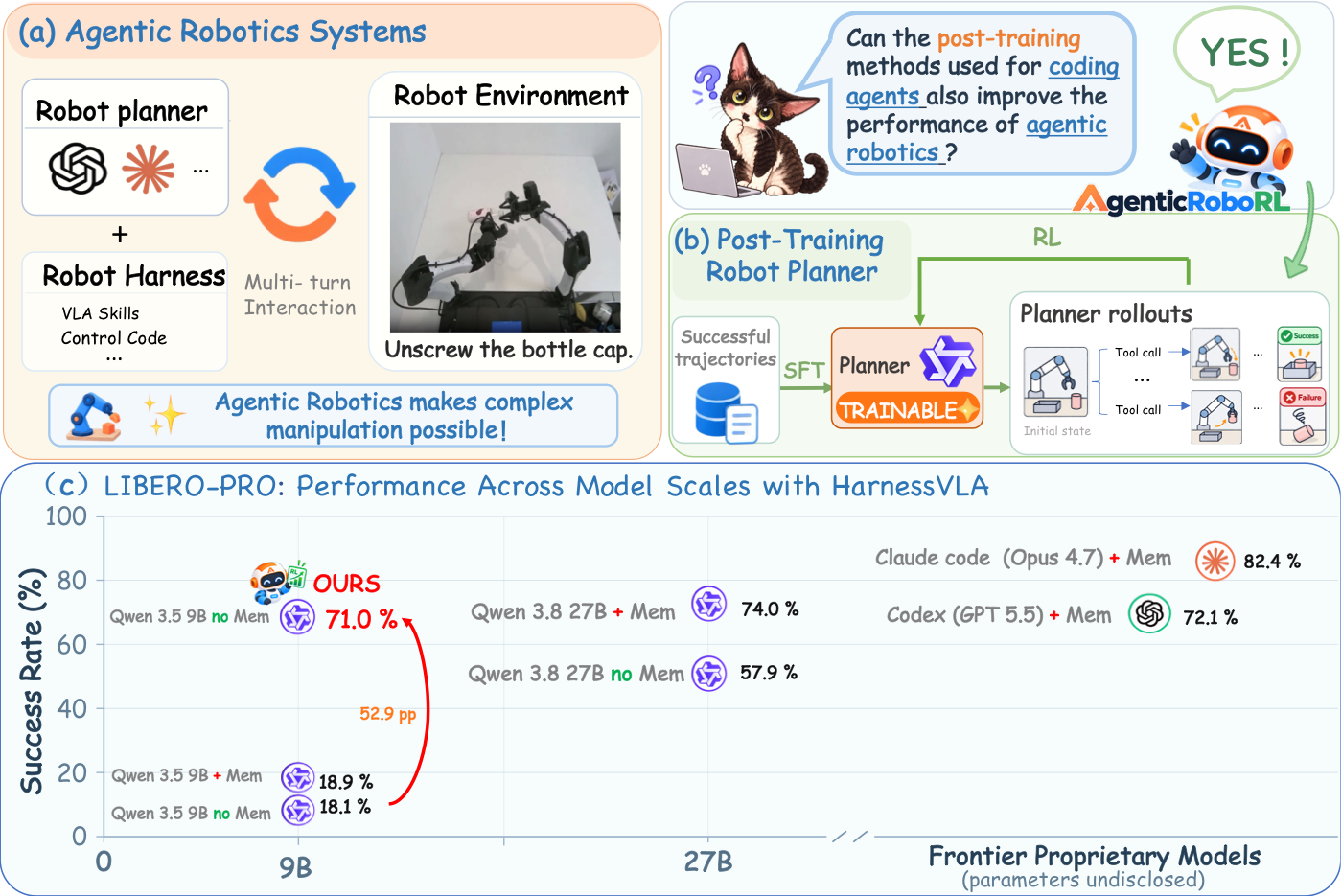
Agentic robotics systems combine planners with robot harnesses to perform complex manipulation tasks. Recent work improves these systems through better harnesses and external memory, but relies on powerful closed-source models as planners and does not improve the planners' own capabilities. In contrast, coding agents have improved substantially by post-training the model itself. We therefore investigate whether post-training can also improve robot planners. However, applying it across robot harnesses requires accommodating different execution mechanisms, including VLA skill invocation and control-code generation. To this end, we introduce AgenticRoboRL, a framework for post-training robot planners across different harnesses. The training recipe combines supervised fine-tuning with multi-turn reinforcement learning. To accommodate different execution mechanisms, harness-specific adapters connect recorded planner interactions with task outcomes, enabling a common RL training pipeline while keeping execution components fixed. On LIBERO-PRO, AgenticRoboRL raises the success rate of a 9B-parameter planner from 18.1% to 71.0% without external memory, approaching the 72.1% achieved by Codex (GPT-5.5) with external memory. These results demonstrate post-training as an effective approach for improving robot planners. We will release the framework and trained planner checkpoints.
2026 - Preprint
 ChunkAct: Action Chunking for Agentic Robotics
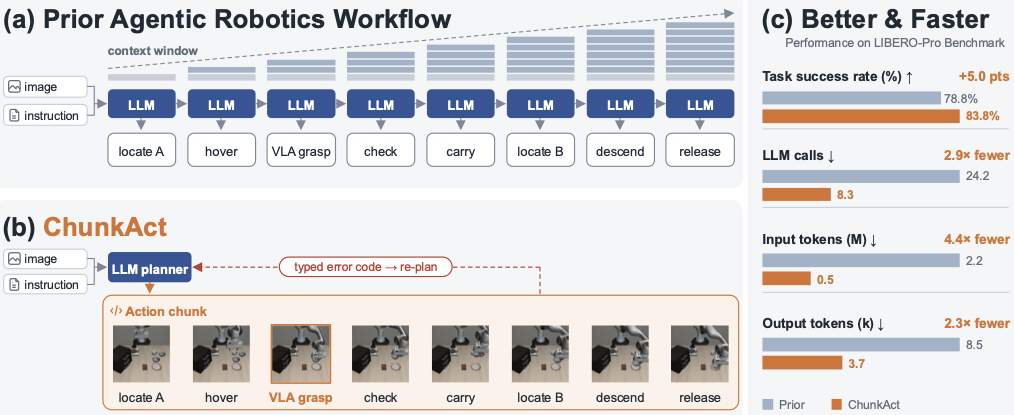
Agentic robotics places a large language model (LLM) agent in the robot control loop, where it composes perception, motion, and vision-language-action (VLA) tools under the guidance of a memory and thereby generalizes to new tasks without retraining. This generality comes at a steep price in efficiency. Every primitive requires a round of LLM reasoning over the full interaction history, so the cost of an episode grows with the number of primitives. We find this reasoning largely redundant: once a sub-goal is chosen, its primitives follow a routine already prescribed by memory. We present ChunkAct, which introduces action chunking to agentic robotics. Online, a single call launches a chunk of chained primitives, which executes autonomously and returns control only upon failure. Offline, ChunkAct compiles the memory into these chunks, so execution is memory-free at test time and the planner is reserved for decisions that require reasoning. LLM computation therefore scales with the number of decisions rather than the number of primitives. On LIBERO-Pro, ChunkAct improves task success by 5.0 points over the state of the art in agentic robotics while requiring 2.9x fewer LLM calls, 4.4x fewer input tokens, and 2.3x fewer output tokens.
2026 - Preprint
 Coding Agents with Harness for Safe Robot Control
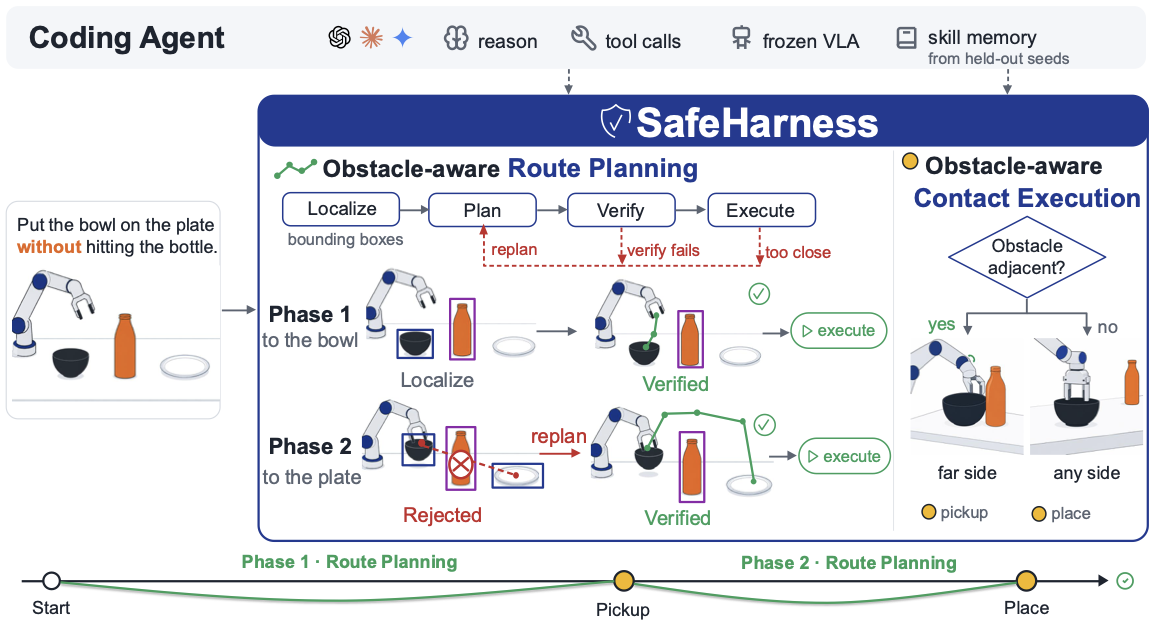
Coding agents have emerged as a promising paradigm for robot manipulation: a language model writes the robot controller as a program, and agents built in this way now operate robots without robot-specific training. Whether this paradigm is also safe, however, has not been asked. We evaluate coding agents under a safety constraint, where each task pairs a manipulation goal with an obstacle the robot must not touch. The agent pursues the goal but collides with the obstacle in most cases, treating task completion as its sole objective. The agent reasons about the obstacle in its traces, and the prompt already forbids touching it, so neither perception nor instruction is at fault; the fault lies in the planning, where the stated constraint never becomes a priority. By decomposing manipulation into a route phase and a contact-rich moment, we locate the source of the failure. Along the route, the model cannot prioritize the safety constraint, having no notion of a clearing route and none of replanning once a chosen route becomes infeasible. At the contact, it is unaware that contact execution is bounded by the same constraint. To close this gap, we present SafeHarness, which equips the model with two obstacle-aware harnesses. Obstacle-aware route planning grounds the objects as bounding boxes and draws candidate routes over them as sequences of waypoints. The agent then plans a route in advance, verifies it, replans when necessary, and only then executes it. Obstacle-aware contact execution instead selects the contact position so that the contact itself avoids the obstacle. SafeHarness attains 81.2% task success and 91.9% collision avoidance with GPT-6-Astra, surpassing the previous SOTA by 13.7 and 23.0 points, and the same agent without harnesses by 31.2 and 57.5 points, respectively.
2026 - Preprint
 Don’t Drop the BATON: Long-Horizon Robot Manipulation via Agentic Subtask Exploration and Transition-aware Memory
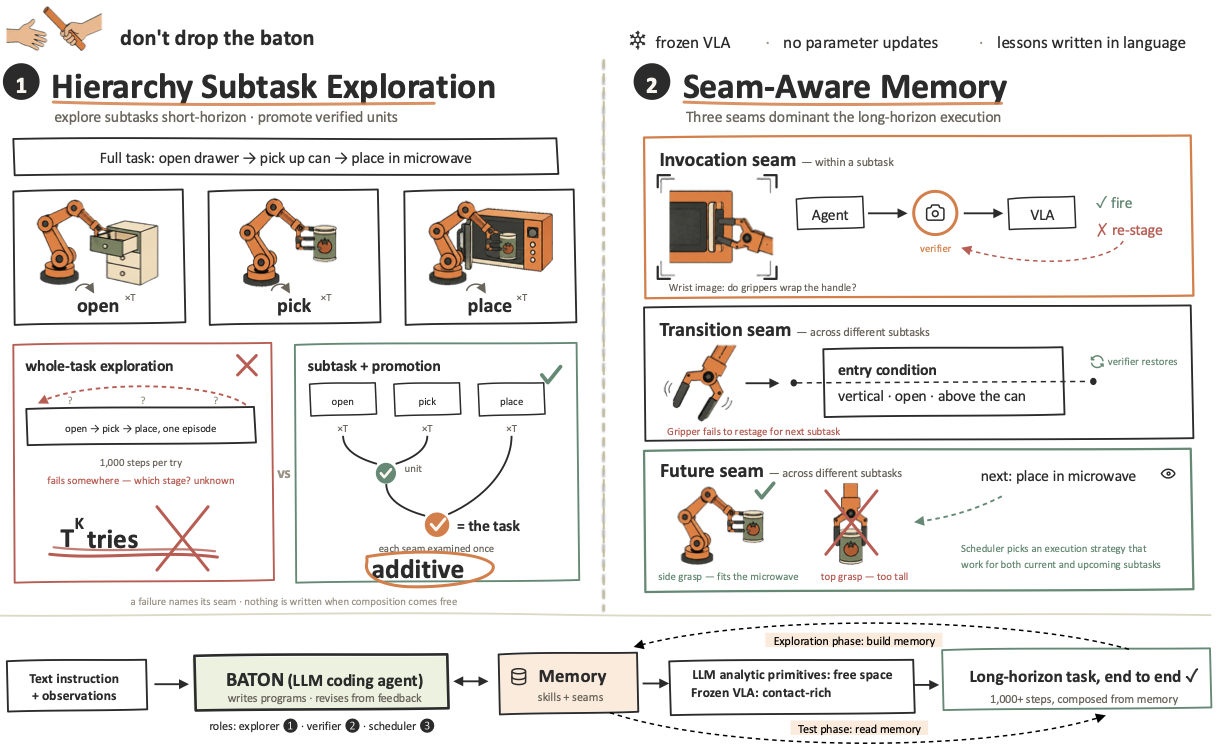
Long-horizon robot manipulation chains many contact-rich skills into one multi-stage task. Vision-language-action (VLA) and world-action models (WAMs) increasingly master individual skills, yet the chain still fails: errors compound beyond the policy's ability to correct, and one subtask silently constrains the next. A promising pathway freezes the VLA and puts an LLM coding agent in charge: it plans in language, moves in free space with analytic primitives, invokes the VLA only for contact-rich segments, and writes adaptation into language memory. Yet applied to long horizons, this recipe breaks twice. (1) Its competence comes from whole-task exploration at test time, whose cost is exponential in the number of stages: if one stage needs T episodes, a K-stage task needs on the order of T^K, and a failure does not reveal which stage caused it. (2) It has no representation of transitions: the VLA primitive carries an exit but no entry condition, and a subtask can succeed in a form its successor cannot use. We present BATON to address both failures. Against (1), BATON makes the subtask the unit of exploration: each subtask is explored in the cheap short-horizon regime and its solution stored in memory; a long-horizon trajectory is then composed from these solutions rather than discovered whole. Exploration cost becomes linear (KT), and each failure is attributed to one stage. Against (2), BATON equips exploration with a transition-aware memory. Within a subtask, a verifier agent governs the invocation transition: the VLA is invoked only after the wrist view confirms the scene is ready. Across subtasks, a handoff transition restores an entry state disturbed by the predecessor's residue, and a lookahead transition selects the strategy whose outcome the successor can inherit. On the RoboMemArena benchmark, BATON improves task success by 37.7% and cumulative success by 29.7% over the SoTA.
2026 - ACL Findings 2026
 SilentDrift: Exploiting Action Chunking for Stealthy Backdoor Attacks on Vision-Language-Action Models
Vision-Language-Action (VLA) models are increasingly deployed in safety-critical robotic applications, yet their security vulnerabilities remain underexplored. We identify a fundamental security flaw in modern VLA systems: the combination of action chunking and delta pose representations creates an intra-chunk visual open-loop. This mechanism forces the robot to execute K-step action sequences, allowing per-step perturbations to accumulate through integration. We propose SILENTDRIFT, a stealthy black-box backdoor attack exploiting this vulnerability. Our method employs the Smootherstep function to construct perturbations with guaranteed C2 continuity, ensuring zero velocity and acceleration at trajectory boundaries to satisfy strict kinematic consistency constraints. Furthermore, our keyframe attack strategy selectively poisons only the critical approach phase, maximizing impact while minimizing trigger exposure. The resulting poisoned trajectories are visually indistinguishable from successful demonstrations. Evaluated on the LIBERO, SILENTDRIFT achieves a 93.2% Attack Success Rate with a poisoning rate under 2%, while maintaining a 95.3% Clean Task Success Rate.
2026
2025
- ICCV 2025
 LLaVA-PruMerge: Adaptive Token Reduction for Efficient Large Multimodal Models[Hot!]
Large Multimodal Models (LMMs) have shown significant visual reasoning capabilities by connecting a visual encoder and a large language model. LMMs typically take in a fixed and large amount of visual tokens, such as the penultimate layer features in the CLIP visual encoder, as the prefix content. Recent LMMs incorporate more complex visual inputs, such as high-resolution images and videos, which further increases the number of visual tokens significantly. However, due to the inherent design of the Transformer architecture, the computational costs of these models tend to increase quadratically with the number of input tokens. To tackle this problem, we explore a token reduction mechanism that identifies significant spatial redundancy among visual tokens. In response, we propose PruMerge, a novel adaptive visual token reduction strategy that significantly reduces the number of visual tokens without compromising the performance of LMMs. Specifically, to metric the importance of each token, we exploit the sparsity observed in the visual encoder, characterized by the sparse distribution of attention scores between the class token and visual tokens. This sparsity enables us to dynamically select the most crucial visual tokens to retain. Subsequently, we cluster the selected (unpruned) tokens based on their key similarity and merge them with the unpruned tokens, effectively supplementing and enhancing their informational content. Empirically, when applied to LLaVA-1.5, our approach can compress the visual tokens by 14 times on average, and achieve comparable performance across diverse visual question-answering and reasoning tasks.
2025


2023
- ICCV 2023
 Causal-DFQ: Causality Guided Data-Free Network Quantization
Model quantization, which aims to compress deep neural networks and accelerate inference speed, has greatly facilitated the development of cumbersome models on mobile and edge devices. There is a common assumption in quantization methods from prior works that training data is available. In practice, however, this assumption cannot always be fulfilled due to reasons of privacy and security, rendering these methods inapplicable in real-life situations. Thus, data-free network quantization has recently received significant attention in neural network compression. Causal reasoning provides an intuitive way to model causal relationships to eliminate data-driven correlations, making causality an essential component of analyzing data-free problems. However, causal formulations of data-free quantization are inadequate in the literature. To bridge this gap, we construct a causal graph to model the data generation and discrepancy reduction between the pre-trained and quantized models. Inspired by the causal understanding, we propose the Causality-guided Data-free Network Quantization method, Causal-DFQ, to eliminate the reliance on data via approaching an equilibrium of causality-driven intervened distributions. Specifically, we design a content-style-decoupled generator, synthesizing images conditioned on the relevant and irrelevant factors; then we propose a discrepancy reduction loss to align the intervened distributions of the pre-trained and quantized models. It is worth noting that our work is the first attempt towards introducing causality to data-free quantization problem. Extensive experiments demonstrate the efficacy of Causal-DFQ.
2023
(*) denotes equal contribution